

The Ultimate Family Travel Packing List (By Age Group)
*This post may contain affiliate links, which means I may earn a small commission if you make a purchase through one of my links, at no additional cost to you. As an Amazon Associate, I earn from qualifying purchases.
Packing for a family trip can get overwhelming surprisingly fast.
Packing for yourself? Usually manageable.
Packing while also remembering everyone’s shoes, pajamas, medications, chargers, swimsuits, headphones, snacks, and the stuffed animal that absolutely cannot be left behind?
That’s a different situation.
I’ve found that family packing gets much easier when you stop thinking of it as one giant packing list. A toddler needs very different things than a teenager, and not everyone needs their own version of every single item.
The goal isn’t to pack for every possible situation. It’s to bring what your family is actually likely to need, keep everything organized, and make sure the important things are easy to find when you need them.
Here’s how I break it down by age.
Before You Start Packing
Before anyone starts throwing clothes into a suitcase, take a few minutes to think through the actual trip.
Check the Weather
Look at the forecast close to your departure date instead of packing only for what the weather is usually like.
Even warm destinations can have chilly mornings, rain, or indoor air conditioning that makes everyone very glad you packed a sweatshirt.
Think Through Your Itinerary
What are you actually going to be doing?
A beach vacation, European city trip, cruise, theme park vacation, and mountain getaway are all going to require different things.
Think about whether you'll need swimsuits, comfortable walking shoes, dressier clothes, rain gear, or anything specific to your destination.
Pack for the trip you’re taking—not every trip you could theoretically take.
Find Out if You’ll Have Laundry
Laundry access changes everything.
If we’re staying somewhere with a washer and dryer, I would much rather do one load of laundry halfway through the trip than pack twice as many clothes.
For longer trips especially, this can save a ridiculous amount of suitcase space.
Decide How Much Luggage You Actually Want to Manage
Just because an airline allows you to check several suitcases doesn’t mean you want to drag all of them through the airport.
At some point, someone will be tired, someone will stop carrying the bag they promised they could carry, and you’ll probably be trying to locate a restroom at the exact same time.
Less luggage is usually easier luggage.
Babies & Toddlers (0–3)
Little kids definitely require the most stuff, but this is also the stage where having a system makes the biggest difference.
You don’t want to be digging through a suitcase for pajamas while holding an overtired two-year-old.
For babies and toddlers, I focus on four things: extra clothing, feeding, diapering or bathroom needs, and comfort.
They need more backup clothing than everyone else because spills, diaper leaks, mystery stains, and general toddler behavior happen.
That doesn’t mean they need three outfits for every day of a weeklong trip.
That is how one very small person ends up with an entire suitcase.
If your child still uses diapers, bottles, formula, or other everyday supplies, think about what you actually need to bring from home versus what you can easily buy once you arrive.
I also always make sure we have the small things that help with sleep and comfort—a favorite stuffed animal, blanket, pacifier, sleep sack, or whatever your child normally relies on.
Keyword here: small.
If the favorite stuffed animal requires its own airplane seat, this may be the perfect time to negotiate.
What Goes in the Carry-On
For younger kids, keep the things you’re most likely to need during the travel day easy to reach.
That usually means diapering supplies if needed, snacks or feeding supplies, medications, entertainment, a comfort item, and at least one complete change of clothes.
And pack an extra shirt for yourself.
If the baby spills, leaks, spits up, or gets sick, there’s a very real chance you’re going to be involved.
Young Kids (4–8)
This is a great age to start giving kids some responsibility for their own travel things.
They’re old enough to carry a backpack and make a few choices.
They’re not quite old enough for me to trust “I packed everything” without checking.
Because “everything” may consist of three stuffed animals, one LEGO minifigure, and a single sock.
Give Each Kid Their Own Backpack
If they’re old enough to carry one, I like each child to have a small backpack for the travel day.
I especially like these foldable backpacks → because they’re lightweight, fold up when you aren’t using them, and come in lots of colors.
I like giving each kid their own color. That way, when all the bags are piled together, it’s easy to tell whose is whose without asking 14 times.
Keep their backpack simple: entertainment, headphones, a snack, water bottle, sweatshirt, and maybe one small comfort item.
Just keep it light enough that you’ll still be willing to carry it when they inevitably decide they’re finished carrying it.
Keep Entertainment Simple
You don’t need to pack an entire toy room.
A tablet, coloring or activity book, favorite book, stickers, or a small game is usually plenty.
Our family loves Uno because it’s small, easy to pack, and works for a pretty wide range of ages.
And download movies and shows before you leave home.
Airport Wi-Fi is not where I want to discover someone’s favorite movie isn’t actually on the tablet.
Bring a Water Bottle
I like everyone to have their own refillable water bottle.
For younger kids, I prefer a smaller bottle that’s easier for them to carry themselves.
Smaller refillable water bottle
For older kids and adults, I like a larger size so we aren’t constantly looking for somewhere to refill.
Larger refillable water bottle
If we’re flying, we bring them empty through security and fill them afterward.
Tweens (9–12)
Tweens are at a great age to start doing most of their own packing.
I give them a list, let them pack, and then do one final check before the suitcase closes.
Trust, but verify.
At this age, they can usually handle their own clothing, toiletries, entertainment, and travel-day bag with a little guidance.
This is also the age when opinions about clothing can suddenly become very important.
I’d rather have them help choose what they’re bringing before the trip than discover on vacation that they apparently hate every shirt they own.
Electronics Become Their Responsibility
If they’re bringing a tablet or phone, they also need to think about the headphones, charger, and downloaded entertainment that go with it.
A good pair of kids’ headphones is one of those things I’m always glad we have on flights and long travel days.
This is also a good age to start making kids responsible for remembering their own charger.
A dead tablet three hours into a travel day is a surprisingly effective lesson in personal responsibility.
Teens (13+)
Teenagers can—and should—take much more responsibility for their own packing.
That doesn’t mean I completely remove myself from the process.
They get a checklist, they pack, and I do a quick review.
The biggest thing I remind teens to do is pack for the actual itinerary instead of throwing their favorite clothes into a suitcase.
If we're going to be walking all day, they need real walking shoes. If there’s a nicer dinner planned, they may need something a little dressier. If we're going somewhere cold, one hoodie probably isn't the entire winter clothing plan.
And yes, I confirm that they packed actual walking shoes.
A trip involving 15,000 steps a day isn’t a great time to discover they brought only flip-flops.
Keep Electronics Organized
Phones, headphones, chargers, watch chargers, and other electronics can quickly become their own category.
I like using zippered organizing pouches to keep cords and chargers together instead of having random cables floating around the bottom of every bag.
I also keep a portable charger charged and easy to reach.
Between boarding passes, maps, airline apps, photos, entertainment, and everyone using their phones more than usual, batteries disappear quickly on travel days.
If your older kids have their own phones, you may eventually decide you want more than one.
Apparently sharing one portable charger when everyone’s phone is at 12% is not a bonding experience.
Don’t Forget the Adults
This sounds obvious.
It is also surprisingly easy to remember everything your children could possibly need and arrive without pajamas for yourself.
Instead of packing yourself last with whatever energy you have left, give the adults their own list too.
Think through your everyday clothing, shoes, toiletries, medications, and anything specific to the destination.
Prescription medications and anything difficult to replace should stay in your carry-on rather than checked luggage.
Not Everything Needs to Be Packed for Each Person
One of the easiest ways to cut down on overpacking is to separate personal items from shared family items.
Your family probably does not need five tubes of toothpaste.
Things like sunscreen, first-aid supplies, some toiletries, charging equipment, laundry supplies, snacks, and destination-specific gear can often be shared.
Deciding who is responsible for the shared items also prevents the opposite problem—everyone assuming someone else packed them.
Want the Complete Lists Without Making Them Yourself?
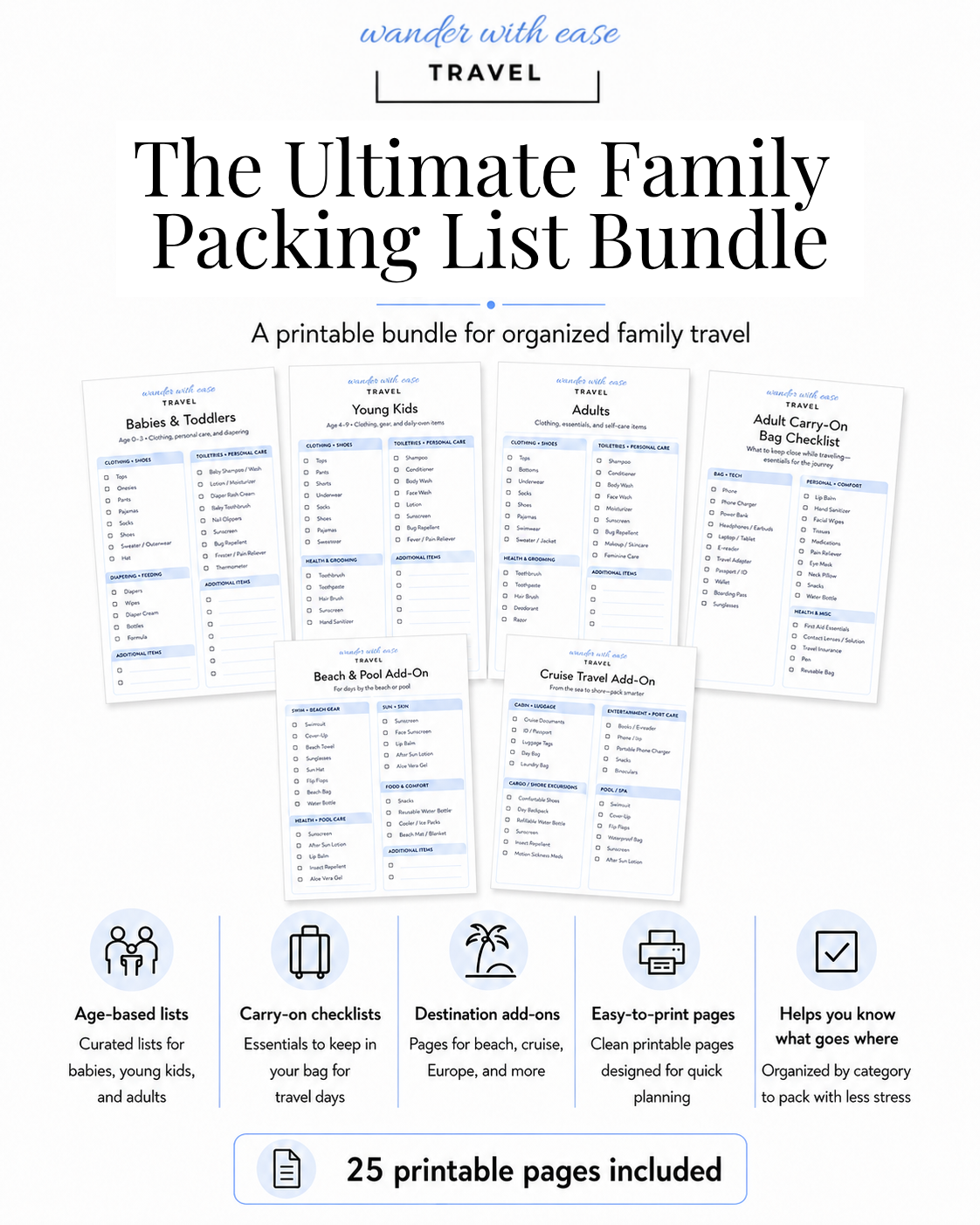
If you would rather skip creating all of these lists from scratch, I made the Ultimate Family Packing List Bundle to do exactly that.
It includes 25 printable pages with age-based packing lists, adult and kids’ carry-on checklists, toiletries, destination add-ons, outfit planning, last-minute packing help, and more.
You can print only the pages that make sense for your trip and use fresh copies again the next time you travel.
Take a look at the Ultimate Family Packing List Bundle →
How Much Clothing Should You Actually Pack?
There isn’t one perfect number.
It depends on the length of your trip, destination, weather, your kids’ ages, itinerary, and whether you’ll have access to laundry.
For shorter trips, I generally plan around one outfit per day with a little extra for younger kids.
For longer trips, I’d much rather do laundry than bring two full weeks of clothing.
Shoes are another place where luggage can get out of control quickly.
They’re bulky, so choose a few versatile pairs that work with most of what you’re bringing.
Use a Packing System
This is what makes the biggest difference for me.
I don’t put everyone’s clothes randomly into a suitcase and hope we remember where everything went.
I use packing cubes.
For family trips, I prefer organizing them by person.
If everyone has their own cube—or even their own color—you can grab exactly what you need without digging through the entire suitcase.
When we arrive, the cubes can also go directly into drawers or onto shelves, which makes unpacking much faster.
Have a Separate Carry-On Plan
Your carry-on deserves its own packing plan.
Anything you absolutely cannot be without should stay with you instead of going into checked luggage.
Think IDs or passports, medications, valuables, important electronics, and anything your family would seriously struggle without if a checked suitcase didn’t arrive with you.
For kids, I also like having a change of clothes and a few travel-day essentials within reach.
If you’re checking luggage, pack as though there’s at least a small chance you and your suitcase could spend the first night of vacation in different places.
You’ll be very glad you did if it ever happens.
Things You Probably Don’t Need to Pack
Good packing isn’t just remembering what to bring.
It’s also knowing what to leave home.
Too Many Toys
A few activities are plenty.
Kids often end up more interested in the hotel pool, airplane window, or random souvenir they found than the bag of toys you carefully packed anyway.
Too Many Shoes
Shoes take up a ridiculous amount of room.
Choose versatile pairs that work with several outfits and activities.
Full-Size Toiletries
For most vacations, travel sizes are plenty.
Remember that many hotels also provide some basics.
Every Possible “Just in Case” Item
A backup outfit?
Smart.
Six backup outfits?
Probably unnecessary.
Unless you’re traveling somewhere extremely remote, you can buy most forgotten basics.
Sometimes spending $8 on something you forgot is better than hauling an extra ten pounds of “just in case” items around for a week.
Do One Final Check—Then Stop
Before the suitcases close, I do one final sweep for the things that would be difficult or especially annoying to replace.
I make sure we have our important documents, medications, necessary electronics, the right shoes, and anything specific to the destination.
Then I stop.
There is a point where continuing to think about packing only results in adding things you don’t need.
Zip the suitcase.
Walk away.
Final Thoughts
Family packing gets much easier when you stop trying to remember everything from scratch before every trip.
Give everyone some responsibility based on their age, pack for your actual itinerary, keep the important things with you, and use a system that makes it easy to find everything once you arrive.
The goal isn’t a perfectly packed suitcase.
It’s arriving with what you need—and knowing where you put it.
If you'd like the complete system ready to print, the Ultimate Family Packing List Bundle has the age-based lists, carry-on pages, destination add-ons, last-minute packing check, and other pages already done for you.
Shop the Ultimate Family Packing List Bundle →
Want Your Entire Trip Organized Too?
If you want more than a packing system, the Wander With Ease Travel Planner keeps your trip budget, reservations, itinerary, packing list, and other important travel details together in one place.
It’s the same kind of system I use to keep all the moving pieces of a trip organized instead of trying to remember which email, note, screenshot, or suitcase something is hiding in.